
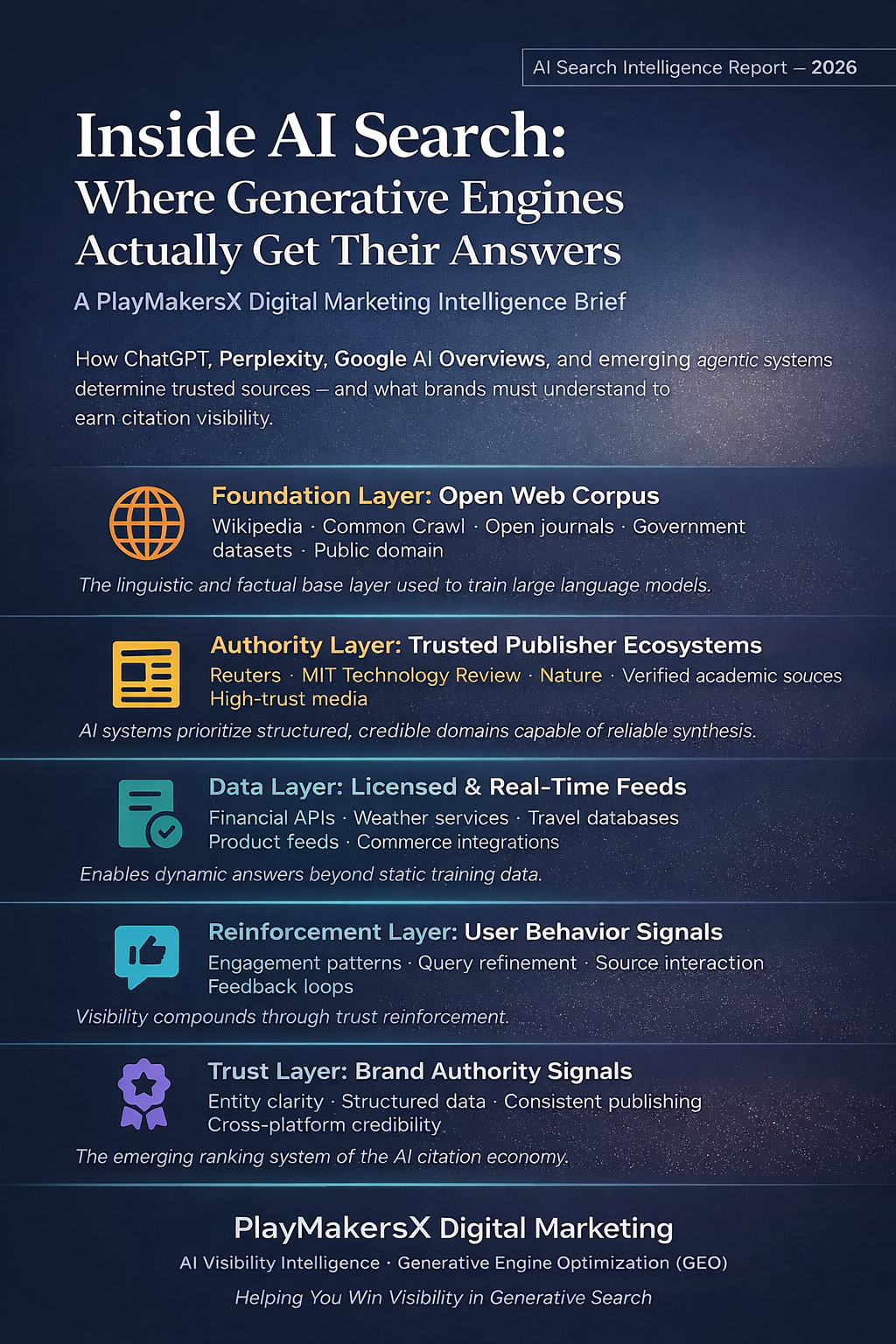
As AI search engines like ChatGPT, Perplexity, Google’s AI Overviews, and Claude reshape how people discover information, one strategic question rises above the noise:
Where do these systems actually source their answers?
AI doesn’t “know” facts the way humans do. It synthesizes information from layered data ecosystems — combining foundational training corpora, trusted publisher integrations, licensed feeds, structured data, and real-time search partnerships.
Understanding those layers is now mission-critical for brands competing in the AI Visibility era.
1. Public Web Data: The Foundation Layer
Every modern large language model (LLM) is initially trained on large volumes of publicly available content, including:
- Wikipedia
- Common Crawl datasets
- Open-access academic repositories (arXiv, PubMed Central)
- Government data portals (data.gov, census.gov)
- Public-domain books and archives
This foundational corpus teaches language patterns, entity relationships, and baseline knowledge.
However, this layer is static. It reflects the state of the web at the time of training — not necessarily the present moment.
That’s why the next layers matter more for brands.
2. Trusted Publishers & Verified Domains
Modern AI search systems increasingly prioritize high-trust domains and licensed partners.
Examples include:
ChatGPT (OpenAI)
Wikipedia, Britannica, Reuters, Associated Press, Stack Overflow, PubMed, .gov and .edu domains
Perplexity
Forbes, MIT Technology Review, ScienceDirect, Nature, arXiv, The Guardian, TechCrunch
Google AI Overviews
Google Search Index (ranked via E-E-A-T signals), Google Scholar, YouTube transcripts, structured schema.org data
Claude (Anthropic)
Open web corpus plus licensed partnerships (The Atlantic, Financial Times, ProPublica)
These are not random citations. They are trust-filtered ecosystems — structured, credible, parsable sources that AI systems can safely synthesize.
In the Citation Economy, being quotable matters more than being indexed.
3. Licensed & Real-Time Data Feeds
AI systems are increasingly connected to structured APIs and licensed databases, including:
- Financial feeds (Nasdaq, Yahoo Finance)
- Sports data (ESPN, league APIs)
- Weather (NOAA, Weather Channel)
- Travel (Amadeus, Expedia, Skyscanner)
- Commerce (Amazon feeds, Shopify data, Google Merchant Center)
This enables dynamic answers such as:
“What’s the current stock price?”
“Best flight from Denver to Austin tomorrow?”
“Top-rated CRM software under $200/month?”
Static blogs alone won’t compete in this layer. Structured integration wins.
4. User Signals & Reinforcement Loops
AI search systems learn from behavior.
- Click patterns
- Prompt refinements
- Follow-up queries
- Source engagement
- Upvotes and feedback
Over time, these signals reinforce which sources are considered helpful, trustworthy, and citation-worthy.
This creates a flywheel:
Trust → Visibility → More Interaction → Reinforced Trust
This is the invisible algorithm most brands are ignoring.
5. The Agentic Shift: What Changes Next
We are entering what PlayMakersX Digital Marketing calls the Agentic Era — where AI doesn’t just answer questions, it acts on behalf of users.
AI agents will:
- Compare vendors
- Filter based on authority signals
- Evaluate transparency and structured data
- Prioritize verified entities
- Execute transactions
In that world, visibility won’t be about ranking position.
It will be about eligibility.
If your brand isn’t structurally trusted, you won’t even be considered.
That is the Great Flattening of digital visibility.
6. Why This Matters for Brands
The battleground is shifting from Google’s Top 10 links to AI’s Preferred Source Lists.
To win, your brand must build:
- Verified authorship & entity clarity
- Structured schema markup (JSON-LD, organization schema, FAQ schema)
- Mentions in trusted publications
- Consistent cross-platform authority signals
- Clear topical depth
At PlayMakersX Digital Marketing, we help brands engineer these signals through:
- Advanced SEO
- Answer Engine Optimization (AEO)
- Generative Engine Optimization (GEO)
- Authority Architecture & Citation Strategy
Because AI search doesn’t just rank pages.
It selects sources.
The Takeaway
AI search curates from structured trust layers:
Public data.
Verified publishers.
Licensed feeds.
Behavioral reinforcement.
Brand authority.
The brands that win won’t be the loudest.
They’ll be the most trusted.
PlayMakersX Digital Marketing
Helping you win visibility in generative search.