
For years, marketers have debated whether AI search would actually drive real business outcomes.
Now we have data.
A new study analyzing nearly 20 million inbound calls reveals that large language models (LLMs) are already influencing which businesses customers choose to contact — and one AI platform is capturing the overwhelming majority of those leads.
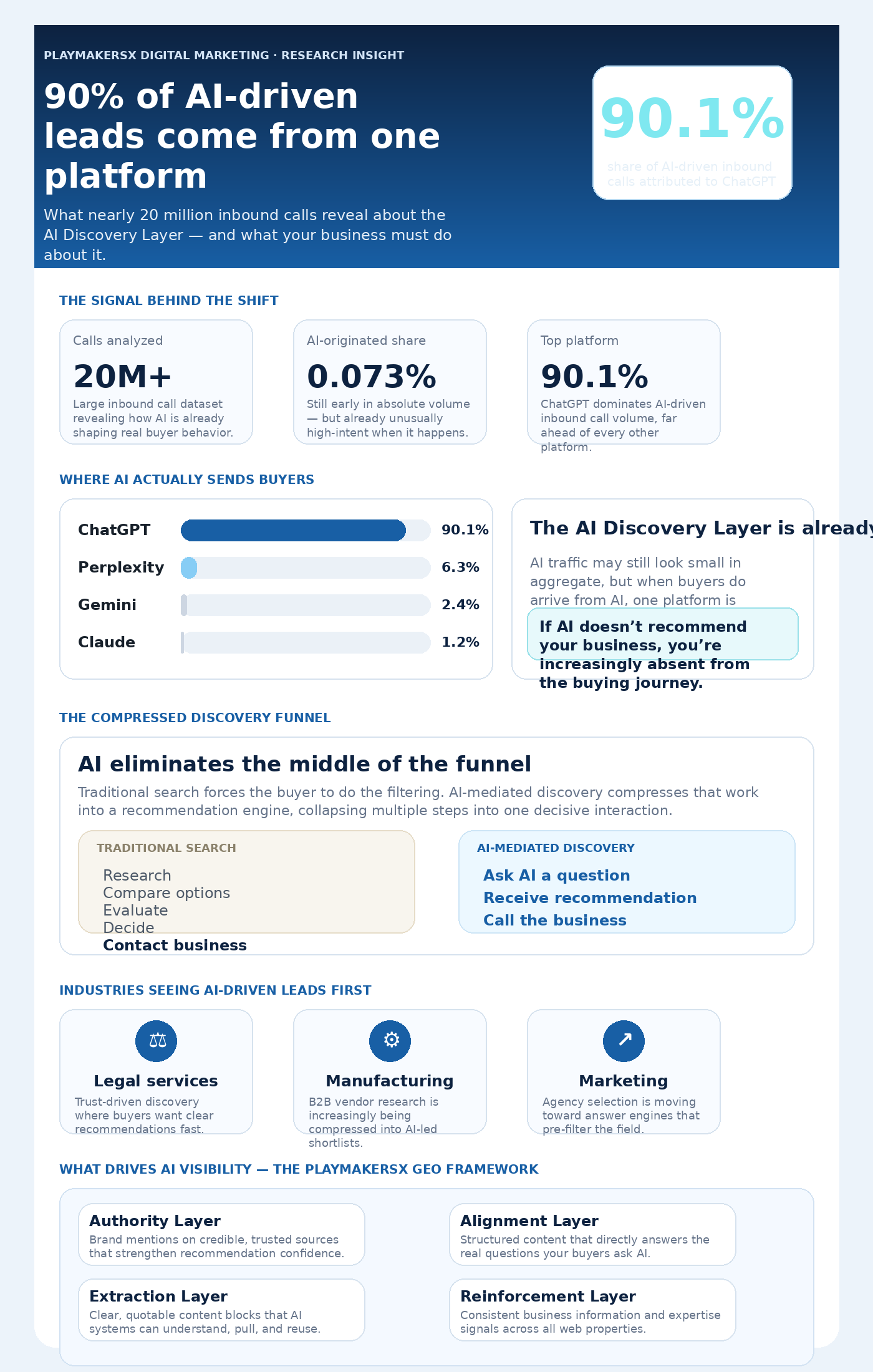
According to the research, ChatGPT drives roughly 90% of AI-generated inbound calls. Perplexity, Gemini, and Claude account for the rest.
This isn’t a trend to watch. It’s a shift already underway.
AI Discovery Is Already Generating Real, High-Intent Leads
The study found that 0.073% of inbound calls currently originate from AI search tools.
That number may sound small. But across tens of millions of interactions, it already represents a meaningful volume of high-intent leads — customers who asked an AI assistant who they should call, and then called that business.
More importantly, the behavior behind these leads is different.
Customers using AI tools aren’t opening ten browser tabs and comparison shopping. They’re asking a direct question:
- “Who is the best HVAC company near me?”
- “Which marketing agency specializes in AI search optimization?”
- “What lawyer handles business litigation in my city?”
Then they call the recommendation.
The traditional discovery funnel — Research → Comparison → Decision → Contact — collapses into something far simpler: Question → AI Recommendation → Phone Call.
That’s a radically shorter path to revenue. And businesses that show up in those recommendations win the business before competitors even know a lead existed.
Why AI-Driven Leads Behave Differently
When a customer asks an AI assistant for a recommendation, they’re not in research mode. They’re in decision mode.
The research confirms several distinct behavioral patterns among AI-referred leads:
They skip the browsing phase entirely. Rather than visiting multiple websites, they receive a curated answer and act on it.
AI recommendations function like trusted referrals. Customers treat AI suggestions with a level of confidence similar to a word-of-mouth recommendation from a peer.
The phone call is often the first meaningful touchpoint. By the time they dial, they’ve already made a significant portion of the buying decision.
Marketers are calling this the compressed discovery funnel — and it fundamentally changes how businesses should think about lead generation, conversion optimization, and customer acquisition costs.
ChatGPT Dominates AI-Driven Business Discovery — For Now
While several AI assistants are influencing customer decisions, one platform currently leads by a wide margin.
Based on analysis of the 20-million-call dataset:
| Platform | Share of AI-Driven Calls |
| ChatGPT | 90.1% |
| Perplexity | 6.3% |
| Gemini | 2.4% |
| Claude | 1.2% |
The implications are significant. For decades, digital marketing strategy centered on Google rankings. Businesses built entire growth engines around organic search visibility, paid placement, and local SEO.
Now a new visibility layer has emerged above search — and ChatGPT currently controls the majority of it.
That won’t remain static. As Gemini, Perplexity, and Claude accelerate their own adoption curves, the competitive landscape inside AI will become increasingly complex. But today, ChatGPT is where most AI-driven leads are originating, and businesses need to be optimized for that reality.
The Industries Seeing AI-Driven Leads First
Not every sector is experiencing this shift equally. Early data points to strong AI-driven discovery signals in industries where expertise, trust, and credibility drive purchase decisions:
- Legal services — Customers seeking attorneys rely heavily on trusted recommendations. AI assistants excel at surfacing providers with demonstrated authority.
- Manufacturing — B2B buyers increasingly use AI to identify specialized vendors and partners.
- Marketing agencies — Decision-makers evaluating agency partners are turning to AI for informed shortlists.
The common thread: these are industries where customers want expert guidance, not just a list of options. AI systems synthesize available information and surface providers that demonstrate clear, credible expertise — which means the businesses that communicate their authority most effectively are the ones getting recommended.
AI Is Becoming the New Gatekeeper Between Customers and Businesses
For the past two decades, Google served as the primary gateway between businesses and the customers looking for them.
That dynamic is evolving.
AI assistants are increasingly operating as a decision layer above search — interpreting the landscape, evaluating options, and presenting a shortlist rather than a page of results. Customers who use these tools don’t browse; they receive a recommendation and act on it.
This is what many in the industry are beginning to call the AI Discovery Layer — and it’s quietly redirecting buying intent at scale.
The businesses that show up inside AI answers will capture the next generation of demand. Those that don’t risk becoming invisible to an increasingly AI-mediated customer base.
What It Takes to Show Up in AI Search Results
Traditional SEO — ranking on Google — is no longer sufficient on its own. Winning in the AI Discovery Layer requires a different discipline: Generative Engine Optimization (GEO).
GEO is the practice of structuring your brand, content, and digital presence so that AI systems recognize and recommend you. The core factors that drive AI visibility include:
Structured, authoritative content. AI systems synthesize information from across the web. Businesses with clear service descriptions, expert-level content, and well-organized information architecture are more likely to be understood — and recommended.
Consistent brand signals. Accurate, consistent business information across directories, review platforms, and web properties signals credibility to AI systems.
Demonstrated expertise. AI assistants evaluate authority. Businesses that publish substantive content, earn credible mentions, and clearly articulate their expertise create stronger signals for recommendation.
Brand presence across trusted sources. Mentions, citations, and references on reputable platforms contribute to how AI systems assess which businesses deserve to be surfaced.
Content built around real customer questions. AI answers questions. Businesses whose content directly addresses the questions their customers are asking are positioned to be part of those answers.
The goal is no longer just to rank. It’s to be cited.
The Trend Line Is Clear — Early Movers Will Win
The CallRail research represents one of the first large-scale measurements of how AI is already shaping real customer behavior — not in theory, but in actual inbound call volume.
And while AI-driven leads represent a fraction of total inbound activity today, the trajectory is unmistakable.
Mobile search followed the same arc: slow early adoption, dismissed as a niche, then dominant. AI-driven discovery appears to be on a similar path — with one critical difference. The businesses building GEO authority today will have a compounding advantage as AI adoption accelerates.
Those that wait may not just fall behind. They may become invisible to AI systems entirely.
The Question Every Business Needs to Answer
It’s no longer enough to ask: “Do we rank on Google?”
The question that now matters is: “Does AI recommend us?”
At PlayMakersX Digital Marketing, we help companies optimize for the next generation of customer discovery through AI Search Optimization and Generative Engine Optimization (GEO). If your customers are already asking AI tools who they should work with — and they are — your brand needs to be the answer.
Learn how PlayMakersX helps businesses become visible across AI search platforms →